
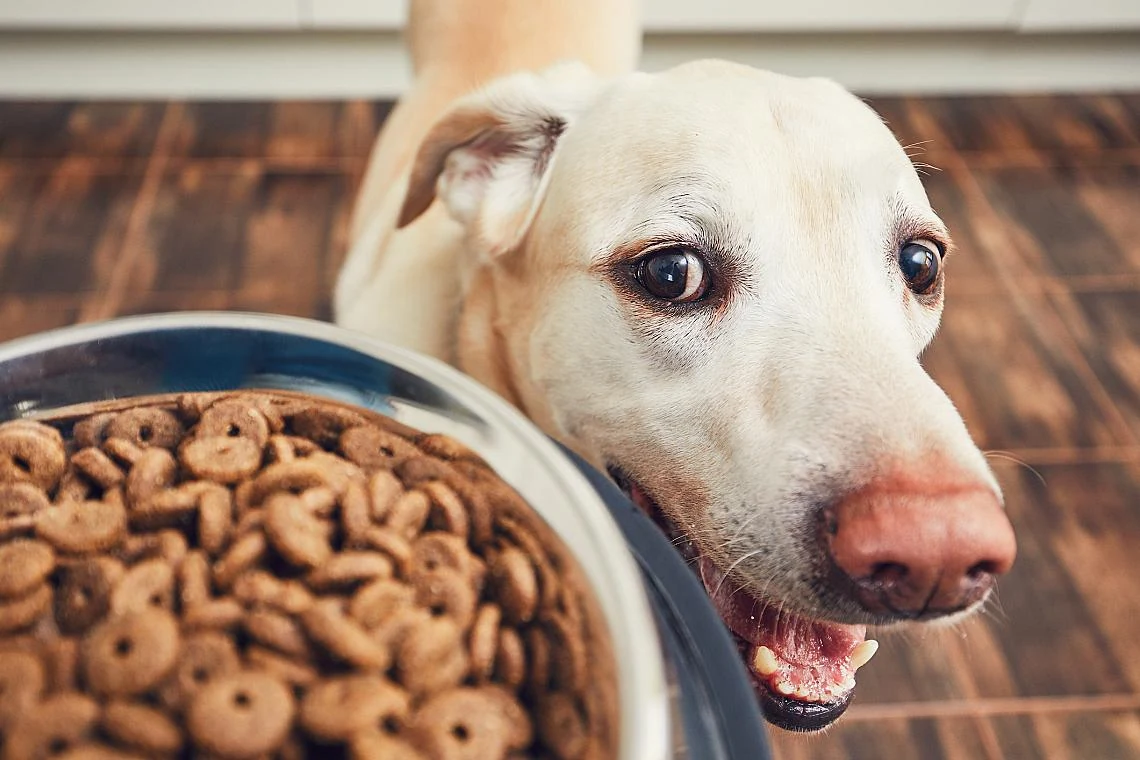
Commercial foods for dogs and cats come in three main forms: dry, canned and semi-moist.
The classifications used depend more on the method of processing and the water content than on the ingredients or the nutrient profile. Complete and balanced commercial diets for dogs and cats are formulated to provide adequate amounts of every necessary nutrient, without an intolerable excess of any nutrient.
Adding certain nutrients to commercial complete and balanced foods for dogs and cats should be done carefully and only with appropriate justification. Dog foods are not satisfactory for cats, because most dog foods have a lower protein content, often do not contain guaranteed concentrations of taurine, and are not designed to produce a urine pH below 6.5, which helps prevent the crystallisation of struvite (magnesium ammonium phosphate) in the urinary tract of cats (feline lower urinary tract disease, FLUTD).
Dry food
This is the most popular category of pet food in the USA and some other countries. Dry foods usually contain about 90% dry matter and 10% water. Approximately 95% of dry dog and cat foods are extruded, that is, made by combining and cooking ingredients (grains, meat and meat by-products, fats, minerals and vitamins), and then pushing the mixture through a die.
During cooking and extrusion, a temperature of about 150°C turns the starch into a more digestible form, destroys toxins and inhibitory substances, and quickly sterilises the product. The food is then coated with fat or other flavourings during drying to improve its taste.
The advantages of dry food include a lower price than canned or semi-moist food, and no need to refrigerate unused portions. Some kinds of dry food can also clean the teeth and gums, helping to reduce periodontal disease.
Canned food
Canned dog and cat foods contain 68%-78% water and 22%-32% dry matter. Given the high moisture content, canned foods generally contain larger amounts of fresh or frozen meat, poultry or fish products and animal by-products.
Many canned pet foods contain textured proteins derived from grains such as wheat or soy. These components act as meat analogues, with a physical structure similar to that of meat and a high nutritional quality. Using meat together with some of the textured proteins not only controls costs but can improve the overall nutritional profile of the final product.
The processing of canned pet food begins with mixing meat or meat analogues and fats with water and dry ingredients, such as vitamins and minerals, to reach the right nutrient content. The mixture is blended and sometimes ground to a fine paste, depending on the product profile.
Once the cans are filled, they are sealed and retorted (a cooking process using heat and pressure that also sterilises the contents), which ensures that food-borne pathogens are destroyed. The advantages of canned food include a long shelf life in a durable container and high palatability.
However, canned food is more expensive than dry food.
Semi-moist food
Semi-moist dog and cat foods contain 25%-40% water and 60%-75% dry matter. They do not need refrigeration and are preserved with humectants, which are substances that bind water so that it is not available for the growth of bacteria and mould, and which give the food its shelf life.
They include simple sugars (usually sucrose), sorbitol and salts. Many semi-moist foods are acidified with phosphoric, malic or hydrochloric acid to slow spoilage further. The advantages of semi-moist foods include convenience, high energy digestibility and palatability.
However, soft moist food is more expensive than dry food.
Home-prepared diets
Dogs can be fed successfully on properly formulated home-prepared diets. This is much harder with cats. The advantages of home-prepared diets include the use of fresh, high-quality ingredients chosen by the owner. The disadvantages include preparation time, variable quality control and consistency of the diet, higher cost, and the difficulty of formulating and preparing a complete and balanced diet.
The hardest thing is to formulate a nutritionally complete and balanced diet with enough nutrients in a small-volume portion. Many home-prepared diets are high in protein and calories, and have inappropriate calcium:phosphorus ratios and inadequate levels of calcium, copper, iodine, fat-soluble vitamins and some of the B vitamins.
Many published recipes for cat diets have very high ash or mineral levels because of the need to add synthetic nutrients. If owners decide to feed their pets a home-prepared diet, they should use a recipe formulated by a veterinary nutritionist (and not recipes found on the internet).
It is also important to realise that no home-prepared diet has undergone the testing and research used to formulate complete and balanced commercial pet foods.
Raw meat-based diets
Raw meat-based diets have received a lot of attention in recent years. The controversy, the lack of good data and the shortage of high-quality research make it difficult for vets to give informed recommendations to pet owners about this way of feeding.
Nevertheless, the American Animal Hospital Association, the American Veterinary Medical Association and the Canadian Veterinary Medical Association have issued statements that discourage feeding dogs and cats raw or undercooked animal protein.
There are two main types of raw meat-based diets: home-prepared and commercial. The variety of raw-dried or frozen pet treats also falls into this category. Home-prepared diets include various feeding regimes, including BARF (Bones and Raw Food, or Biologically Appropriate Raw Food), the Ultimate Diet and the Volhard Diet.
Commercial raw meat-based diets are most often fresh, frozen or pasteurised. Some of these commercial diets are formulated to meet AAFCO nutrient profiles, but many are not.
One of the biggest disputes about these kinds of diets is their safety, not only for the pets that eat them but also for their owners. Even if owners buy meat intended for human consumption to make home-prepared diets, there is no guarantee that these ingredients are free of pathogens and safe to eat raw.
Raw chicken is a common source of Salmonella, and it is thought that 21%-44% of chicken bought from outlets intended for human consumption across North America is contaminated with Salmonella. Even if a pet owner takes precautions when handling and preparing these diets, it has been shown that even after a single meal of Salmonella-contaminated food, 44% of dogs shed Salmonella in their faeces for 7 days, and none of these dogs showed symptoms of Salmonella infection.
The rate of Salmonella contamination for beef and pork intended for human consumption is estimated at 3.5%-4%. But beef and pork are a source of other potential pathogens, including the pathogenic strain E. coli O157:H7. Campylobacter spp. is thought to be present in 29%-74% of chicken, and Listeria spp. in 15%-34% of chicken and 25%-52% of beef and pork.
Two separate studies have shown that eating raw meat significantly increases the seroprevalence of Toxoplasma gondii in cats.
Some commercial raw meat-based diets are frozen or freeze-dried; however, neither freezing nor freeze-drying destroys all potential pathogens in these products. Some commercial manufacturers of raw meat-based diets now use high-pressure pasteurisation in an attempt to reduce the risk of pathogens.
Although this process can reduce the numbers of many pathogens, it generally does not eliminate them completely, and bacteria and viruses differ in their sensitivity to this process. Commercial pet foods have also been recalled in recent years because of Salmonella contamination.
However, given the number of commercial pet food products on offer, the percentage of affected products is relatively small compared with the number of affected raw meat-based diets.
Another problem, especially with home-prepared raw meat-based diets, is nutritional imbalance. In a European study that evaluated 95 home-prepared raw meat-based diets fed to dogs, 60% of them had major nutritional imbalances.
There are a number of case reports of vitamin D-dependent rickets type I and nutritional secondary hyperparathyroidism in dogs fed raw meat-based diets. Other concerns about feeding dogs and cats raw meat and bones are the risks of foreign bodies in the oesophagus and intestines, and of perforation.
Feeding raw bones is also linked to broken teeth and other dental problems in dogs.
Supporters of raw diets often claim that raw meat-based diets are the evolutionary diet of dogs and cats, and that domestic dogs and cats never evolved to be able to digest commercial pet foods. However, a recent report shows that dogs have 36 regions of the genome that differ from those of wolves, and 10 of these regions play a critical role in starch digestion and fat metabolism.
Therefore, the genetic make-up of domestic dogs and cats is not the same as that of wolves. Supporters of raw diets also claim that cooking destroys the essential enzymes needed for digestion. While a small amount of protein is broken down during cooking, and enzymes are proteins, there is no evidence that animals or people need these external sources of enzymes.
In addition, many of these enzymes are destroyed in the highly acidic environment of the stomach and never reach the small intestine, where most nutrients are absorbed.
Finally, vets must also consider the potential legal consequences of recommending raw meat-based diets. While the risks of zoonoses can be linked to feeding both commercial and home-prepared diets, if a pet owner, for example, develops a Salmonella infection from feeding a contaminated commercial diet, the pet food manufacturer is usually at risk of a lawsuit.
However, vets who recommend home-prepared raw meat-based diets are potentially liable if the owner becomes ill from preparing these diets or as a result of pets shedding pathogens in their faeces.
This article is general information and does not replace an examination and individual advice from a veterinarian.