
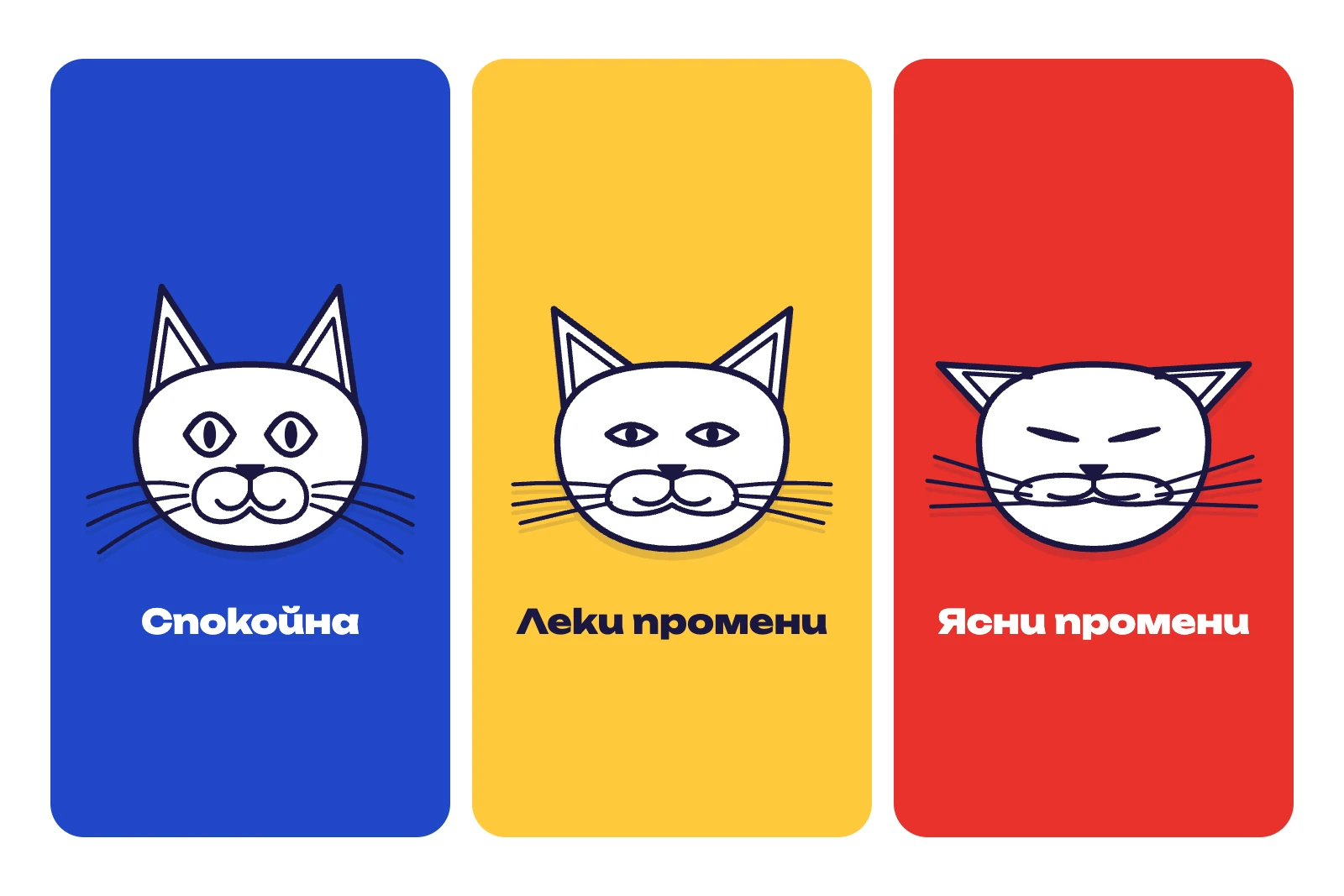
Cats rarely show pain openly. They often do not cry out or limp visibly, they simply become quieter. That is why many owners notice that something is wrong only when the problem is already advanced.
The good news is that there are signs every owner can learn. Some show in the cat's face, others in its behaviour.
The face gives the pain away
Vets at the University of Montreal in Canada created a scale that recognises pain from a cat's facial expression. It is called the Feline Grimace Scale. Studies show that owners use it almost as accurately as veterinarians do.
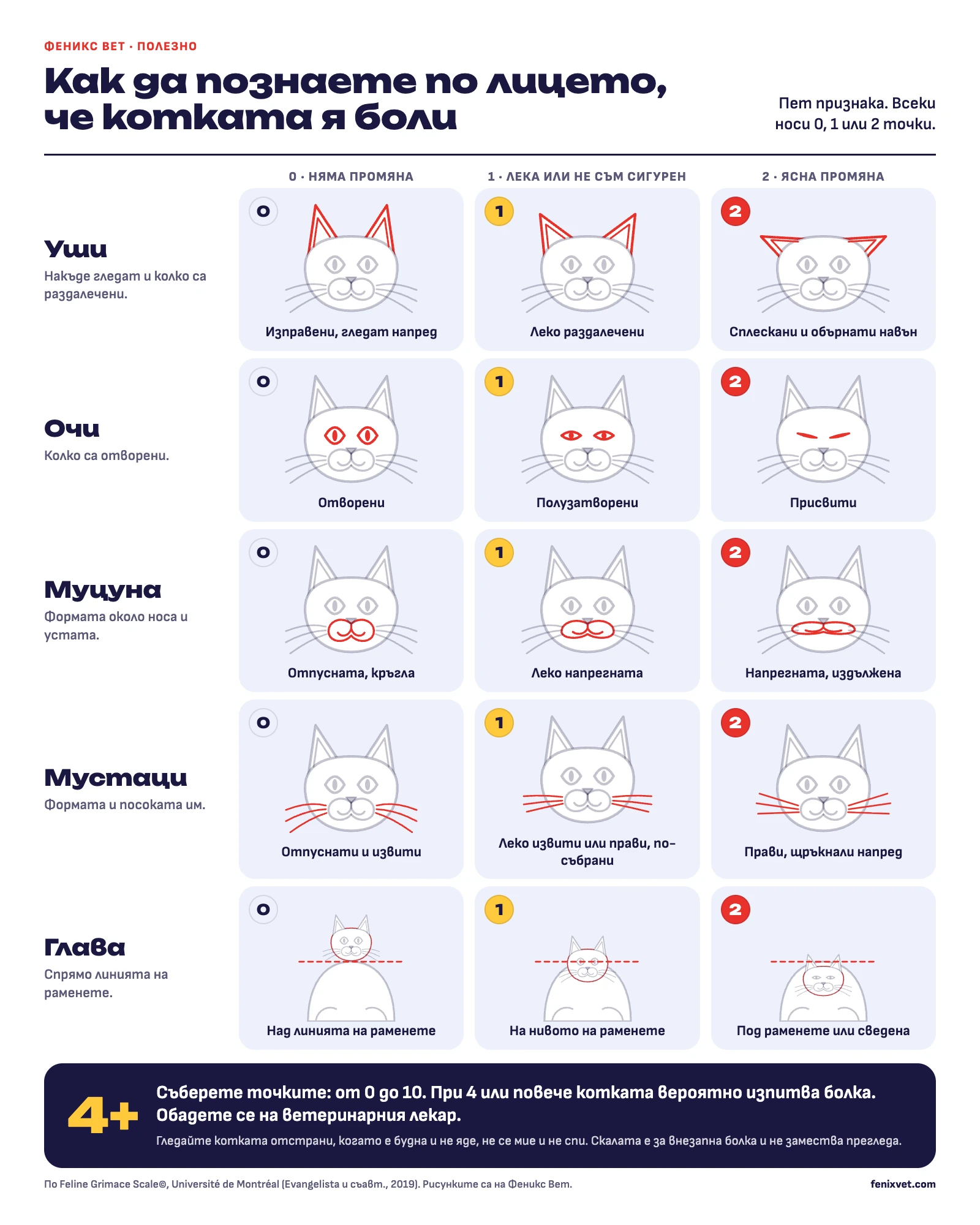
The scale looks at five signs. Each one is given a score from 0 to 2:
- 0 points: the sign is absent
- 1 point: the sign is moderately present, or you are not sure
- 2 points: the sign is markedly present
The five signs
- Ear position. 0: upright, facing forward. 1: the tips are slightly apart. 2: flattened and turned outwards.
- Orbital tightening. 0: eyes open. 1: eyes half closed. 2: eyes squeezed, almost shut.
- Muzzle tension. 0: relaxed, with a rounded shape. 1: slightly tense. 2: tense and elongated.
- Whiskers change. 0: relaxed and curved. 1: slightly curved, or straight and closer together. 2: straight and pointing forward, away from the face.
- Head position. 0: above the line of the shoulders. 1: level with the shoulders. 2: below the line of the shoulders, or lowered with the chin towards the chest.
How to score your cat at home
- Watch your cat from a distance, without calling it and without touching it. It should be awake and, at that moment, not eating, grooming or sleeping.
- Give each of the five signs a score of 0, 1 or 2. The diagram above will help you.
- If a sign is hard to see, leave it out.
- Add up the points. The highest possible score is 10.
- With 4 or more points, your cat is probably in pain. Call your vet. The threshold of 4 points also applies when you have scored only four of the signs.
The University of Montreal also has a Feline Grimace Scale app for iOS and Android phones, which lets you score your cat from a photo.
When the scale is not enough
- The scale has been validated for sudden pain: after an injury, after surgery or with an acute illness. For long-term pain, such as arthritis, also watch for the behaviour described below.
- Eye problems, a head injury or recent anaesthesia change the face on their own. In that case the scale may not be accurate.
- A low score does not definitely mean your cat is not in pain. If you are worried, call us.
- The scale does not replace an examination. It helps you decide when to seek a vet.
Behaviour gives clues too
Veterinary specialists in feline medicine have agreed on about 25 behavioural signs of pain. You do not need to see all of them. Any one of them is reason enough to call us.
Movement and posture:
- Limps or walks unusually
- Has difficulty jumping, or no longer jumps to favourite spots
- Does not want to move
- Shifts weight from one leg to another
- Sits hunched or with the head held low
- Reacts when touched in a particular spot
- Keeps licking the same spot on the body
Habits and mood:
- Hides and withdraws from people
- Stops grooming
- Plays less and is less active
- Eats less, or eats differently from usual
- Rubs against people less often
- Mood or character changes
Signs that more often go with stronger pain:
- Growls or groans
- Keeps the eyes closed
- Avoids bright places
- Breathes rapidly with the mouth open
- Pupils are dilated
If your cat strains in the litter tray and passes little or no urine, call straight away. This may be an emergency.
What to do
- Call the practice and describe what you see. If you can, photograph your cat's muzzle or record a video. This helps the vet.
- Do not give your cat medicines meant for people. Some painkillers, such as paracetamol, are poisonous to cats.
- The sooner we find the cause of the pain, the more easily we can help your cat.
This article is general information and does not replace an examination and individual advice from a veterinarian.